The use of cone beam computed tomography (CBCT) is increasing, and as such, it's something all dental professionals should be familiar with - it is not a specialist or hospital-based exam.
It's also strictly controlled, with two pieces of statute legislation regarding ionising radiation use. No other area of dentistry has such regularly updated and rigid statutes.
While we have not explicitly seen a member go to the GDC specifically for lack of CBCT training, CBCT as a concept has come up in numerous GDC fitness to practise and court cases, and it's likely that with increasing use, and increased awareness from claimants' solicitors, this will increase.
There are also currently very few GDC registered specialists in dentomaxillofacial radiology (DMFR) and even fewer who are legally trained, but it is likely more GDPs will present themselves as experts to the GDC and the courts.
Dento-legal complications with CBCT
Ultimately, we are a patient-focused vocation and they are at the centre of what we do. Practical mistakes are well discussed, and we take great lengths to mitigate; the same is probably not true for administrative errors, as can occur with CBCT.
Here we'll look at some of the areas that can give rise to dento-legal issues from using CBCT in practice – namely, training and reporting.
CBCT as a concept has come up in numerous GDC fitness to practise and court cases, and it's likely that with increasing use, and increased awareness from claimants' solicitors, this will increase.
Training
The European Academy of Dentomaxillofacial Radiology (EADMFR) and the Faculty of General Dental Practice/Public Health England (FGDP/PHE) produced training guidelines in 2014 and 2020, respectively.
'Guidance notes for dental practitioners on the safe use of x-ray equipment' focuses on the PHE guidance. This is based on the earlier EADMFR guidance, which is UK-specific and more recent.
The guidance sets out the different levels of training available:
- Level 1 (core) - for all involved in CBCT
- Level 2 (operator) - for those taking the CBCT scans. Possibly a dental nurse, radiographer or dentist. Level 1 is a pre-requisite
- Level 2 (reporter) - for dentists reporting a CBCT scan. Again, level 1 is a pre-requisite.
When looking for training courses, consider two main factors - who provides the training, and how long it lasts.
Who can provide training?
It would be highly recommended to have this provided by a specialist dental and maxillofacial radiologist, who is registered with the GDC and is on the specialist list. That person is likely to have the skillset to teach the content for dentoalveolar CBCT.
A medical radiologist is also a possibility and will understand the physics and image optimisation, but may be less able to teach the dental specifics and nomenclature that come with a formal dental degree.
The many processes that occur during imaging are referred to as the imaging chain, which is described in an earlier DDU article.
How long training lasts
The UK guidance says that “formal training should last at least six hours with a further six for self-study and small group study, including case-based discussions, interpretation exercises and mentoring.”
It would be highly worthwhile completing the full 12 hours. From a professional point of view as a radiology specialist, I am unsure six hours would be sufficient for safe dentoalveolar CBCT reporting.
How to write a CBCT report
A good report should probably follow a structure and include all the salient points. The clinical question should be answered, but if this is not possible, the report should explain why and make helpful suggestions.
- For example, if the request states “non-specific dental pain URQ” and the scan included UR765 only, one might say, “no apical disease in the imaged volume, although a larger field of view to include UR87654321 may be helpful”.
Reports should generally refrain from directing treatment, as the whole clinical examination and information is not known by the reporter.
An example CBCT report template can be found in 'Guidelines and template for reporting on CBCT scans'.
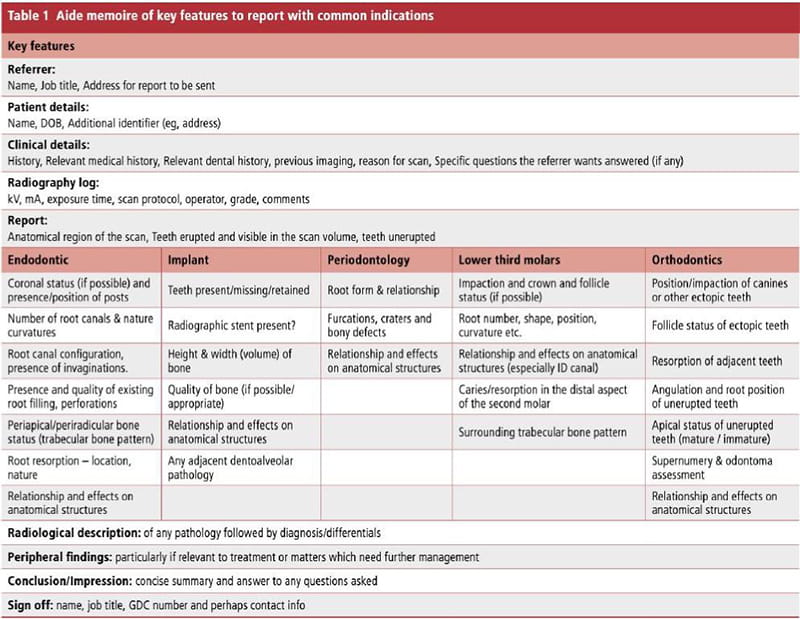
Table produced with permission of the authors.
What information to include
CBCT referral/request
A CBCT referral/request should provide enough information to justify the scan. If possible, include the area of interest to be imaged, a working diagnosis, relevant clinical information from the exam, relevant medical or dental history, specific clinical questions and reference to other tests (and why they were insufficient).
See the examples below:
- CBCT to assess UR654 apical tissues, apical periodontitis, no RMH, no teeth TTP, IOPA unclear
- CBCT to assess LL8, recurrent pericoronitis and treatment planning. No RMH, DPT unclear
- CBCT of whole mandible to assess bone disease, MRONJ, patient had 10 IV bisphosponate infusions over last 5 years, CBCT for disease extent and treatment planning.
The Ionising Radiation (Medical Exposure) Regulations 2017 (IRMER) requires all CBCT exams to be justified by a practitioner - that is, weighed and balanced for the risks and benefits. Fortunately, modern dentoaolvear CBCT is extremely low dose and the benefits can be significant for many areas of dentistry.
CBCT capture/processing
There should be a record that ID was confirmed with the patient, and the correct area of the patient is being imaged. For example, “The patient was asked, 'We are planning to take an image of your right wisdom tooth, is this correct?', and they confirmed it was.”
The exposure factors should be recorded to document accordance with the 'as low as reasonably achievable' (ALARA) principles, but also so that any unusual artefacts or appearances can be replicated by the engineer during quality assessment (QA).
Finally, use a formal QA grading system: A = acceptable, N = not acceptable.
There should be the ability to include notes with the scan. For example, if a patient moves during the scan, two examples could be as follows:
- Patient moved during the scan but does not feel able to have another scan - this is best available.
- Patient moved during scan as sneezed. Happy to repeat. Second scan better quality.
If the scan is N (= not acceptable), the reason should be recorded.
![Red Whale CPD banner ad visual]()
What should you do if you see something you don't recognise?
Practitioners should have a referral mechanism in place before imaging. Most dental hospitals do not have provision to accept referrals from private dental practices for CBCT opinions, so a practice undertaking CBCT would be advised to set up a referral pathway for such cases.
Ultimately, if a malignancy is suspected, an urgent (two-week wait) referral should be made to the nearest oral and maxillofacial surgery (OMFS) NHS unit.
The scan should be sent securely to the Picture Archiving and Communication System (PACs) department of that hospital as DICOM files so it can be uploaded in anticipation of the OMFS appointment. A CD containing the images sent with the referral letter is unlikely to be able to be used by the clinical team on the day and could delay treatment.
Further resources and advice
There are many resources for CBCT, but most can be distilled into the PHE guidance, which is comprehensive and written for dental professionals.
Hopefully the articles referenced here - along with this one - will equip all members of the dental team to safely and effectively use CBCT.
As always, if you are unsure, stop, ask a colleague, and if in doubt ask your indemnity provider for advice.
The views and opinions expressed in this article are those of the author and do not necessarily reflect those of the DDU.
Mr Simon C Harvey
Simon is a consultant in dental and maxillofacial radiology at The Eastman Dental Hospital, London and Queen Victoria Hospital, Sussex. His subspecialty clinical interests are dentoalveolar cone beam computed tomography (CBCT) and salivary gland interventional radiology.
A passionate educator, Simon has been employed in dental education for over a decade. He lectures regularly to dental professionals and designed and runs the British Dental Association CBCT reporting Masterclass. He is published in several peer reviewed journals and has co-authored a best selling textbook on CBCT use in Endodontics, translated into four languages.
He is an examiner at The Royal College of Surgeons and sits on the committee of the education charity Teeth Relief. He has an interest in dento-legal disputes and holds a Masters degree in Medical Law and Ethics from the King's College London School of Law. He sits on the DDU dental advisory committee and acts as an independent expert witness.
See more by Mr Simon C Harvey